
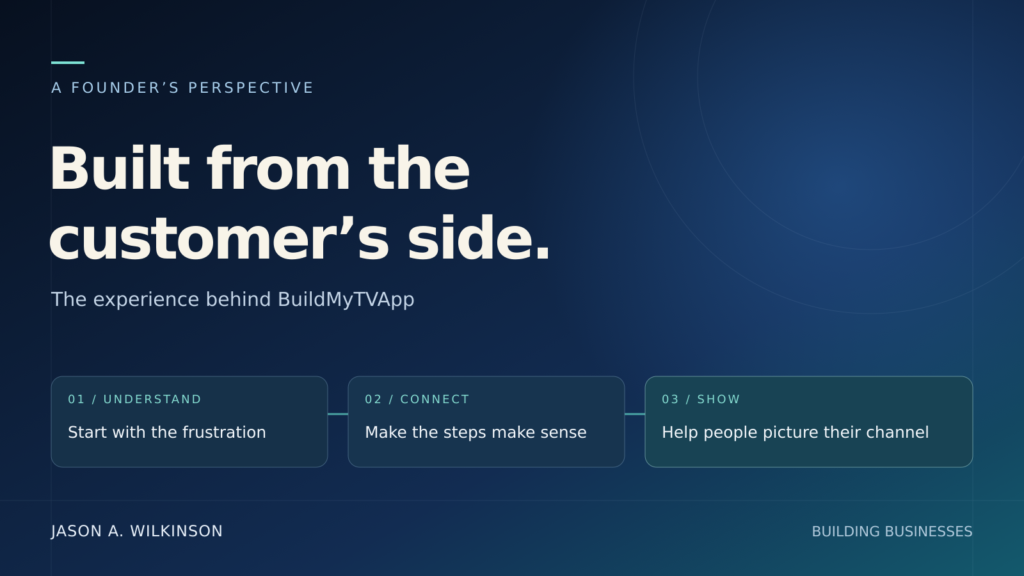
Building BuildMyTVApp · A founder’s perspective
The idea began with a simple frustration: I wanted more control over my own TV channel. Building the solution has taught me how much work goes into making that experience feel straightforward.
Before I started building BuildMyTVApp, I was the customer asking for help.
I had used another platform to manage my TV channels. When I needed to make a change, I often had to go back to the company and ask. Then I had to wait. In my experience, the answers were sometimes so brief that I still didn’t understand what I needed to do. Asking for clarification didn’t always make things clearer.
That stayed with me. I wanted to make decisions about my own channel without feeling stuck every time I needed something changed.
I remember thinking that if I ever had the opportunity, I would build my own version. That became the starting point for BuildMyTVApp.
The cost of getting started mattered, too
Other options I looked at were difficult to justify as an independent creator. A large setup fee was only part of the cost. There could also be a monthly platform fee and the separate expense of hosting the content.
I wanted a TV channel. I didn’t want to commit thousands of dollars just to get started before I had worked out how the whole thing would fit into my business.
That experience shaped what I wanted to build: a clearer, more approachable way for people to bring their content to television. Churches, podcasters, live streamers, business owners and other video creators should be able to understand what they’re paying for, what they control and what happens next.
Affordability and clarity have to be considered together. A lower price only goes so far if someone still feels lost using the product.
Building it changed how I see the work
The hardest part has been connecting everything so that it makes sense as one experience.
When you’re a customer, you see something you’d like added and naturally think, “That would be useful.” Once you’re building the product, you start to see how many other parts that change can affect.
Content, branding, previews, channel setup and publishing all have to work together. Someone shouldn’t have to understand the underlying software just to figure out where to go next.
I didn’t fully appreciate that complexity before I started. Working through it has taught me much more about connected TV, streaming delivery and building a software business. It has also given me a better understanding of the developer’s side of the conversation.
But I still remember being the person waiting for an answer. That’s useful perspective to keep. Understanding why something is difficult should help me explain it better to a customer.
The preview is the part I’m especially proud of
If I had to choose one part of the platform that means the most to me, it would probably be the branding and preview area.
There’s something exciting about seeing your own branding and content come together in a TV-style preview before the channel is published. You’re no longer trying to imagine everything from a list of settings.
I want a creator to look at that screen and think, “My channel could really look like this. I could turn on my TV and see something I built.”
The preview also has a practical purpose. It gives people a clearer way to judge their artwork, content and presentation as they make decisions. A browser preview helps with that process; checking the finished app on the actual TV platform still matters.
For me, this is where the technical work starts to connect with the reason someone wanted a channel in the first place. They have content they care about, and they want to picture it reaching an audience.
Helpful explanations belong in the product
I’m also thinking about the things I wished I’d had access to when I was building my earlier Roku and Fire TV channels. Live streaming is one of those areas. Bringing it into the platform has been a priority because I know how useful a more connected workflow would have been to me.
Just as importantly, I want the explanations to be understandable. Someone who works with this technology every day can forget how unfamiliar it is to a person opening the dashboard for the first time.
These are the questions I want the experience to answer clearly:
- What do I need to do next? Make the next step easy to find.
- Why does this matter? Explain the reason behind a requirement.
- What will happen when I make this change? Help people understand the result before they commit.
- Where can I get help? Give people useful guidance when they get stuck.
My goal is to support that with helpful videos and knowledgeable support as the business develops. I want people to feel comfortable asking a question, including the questions that might seem obvious to a developer.
What I’m taking into the rest of my work
Building this platform has reinforced something I want to carry across my projects: stay close to the person who will actually use what I’m making.
That means thinking about the whole experience, including the explanations and the moments when something doesn’t go as expected. It also means being willing to learn how much work sits behind a feature that looks simple from the outside.
I’m proud of the platform I’m building. I’m especially proud that the original reason for building it still guides the decisions: I’ve been the creator trying to get a channel running, and I want to make that experience easier for someone else.
Explore BuildMyTVApp, or visit My Work on JasonAWilkinson.com to see the other projects I’m developing.